Solar first, generator as backup:
the hybrid system in Chad
In the Abéché region, in eastern Chad, a borehole supplies a town and its livestock with 100 m³ per day. The existing generator is to be kept as backup, starting automatically when solar output is no longer sufficient. The study looks at this hybrid architecture and at the coverage provided by the existing tanks.
The need, as the NGO expresses it
Water for a Sahelian town is not negotiable: residents, passing herds, small dry-season market gardening. The network relies on a water tower and tanks totalling 95 m³, filled until now on diesel. The association's goal is not to remove the generator: it is to make it fall silent. Solar as the main source, the generator as automatic backup, with no human intervention.
Chad is proven ground for solar pumping: documented installations have been running there for over ten years, including on larger supply systems than this one, often led by NGOs and international solidarity associations. In the Sahel, a kWh produced from diesel costs 3 to 4 times a solar kWh: every hour of sun used is an hour of generator run time saved.
The input data in LE LAB
A few minutes of input. The solar reference city is Abéché, at the heart of the project region. Borehole at 50 m, delivery head of 15 m to the tower, 200 m of pipe: the total head is calculated automatically, 72 m. And one answer carries more weight than the others: electrical backup, yes. It is this answer that steers the study toward a hybrid solution.
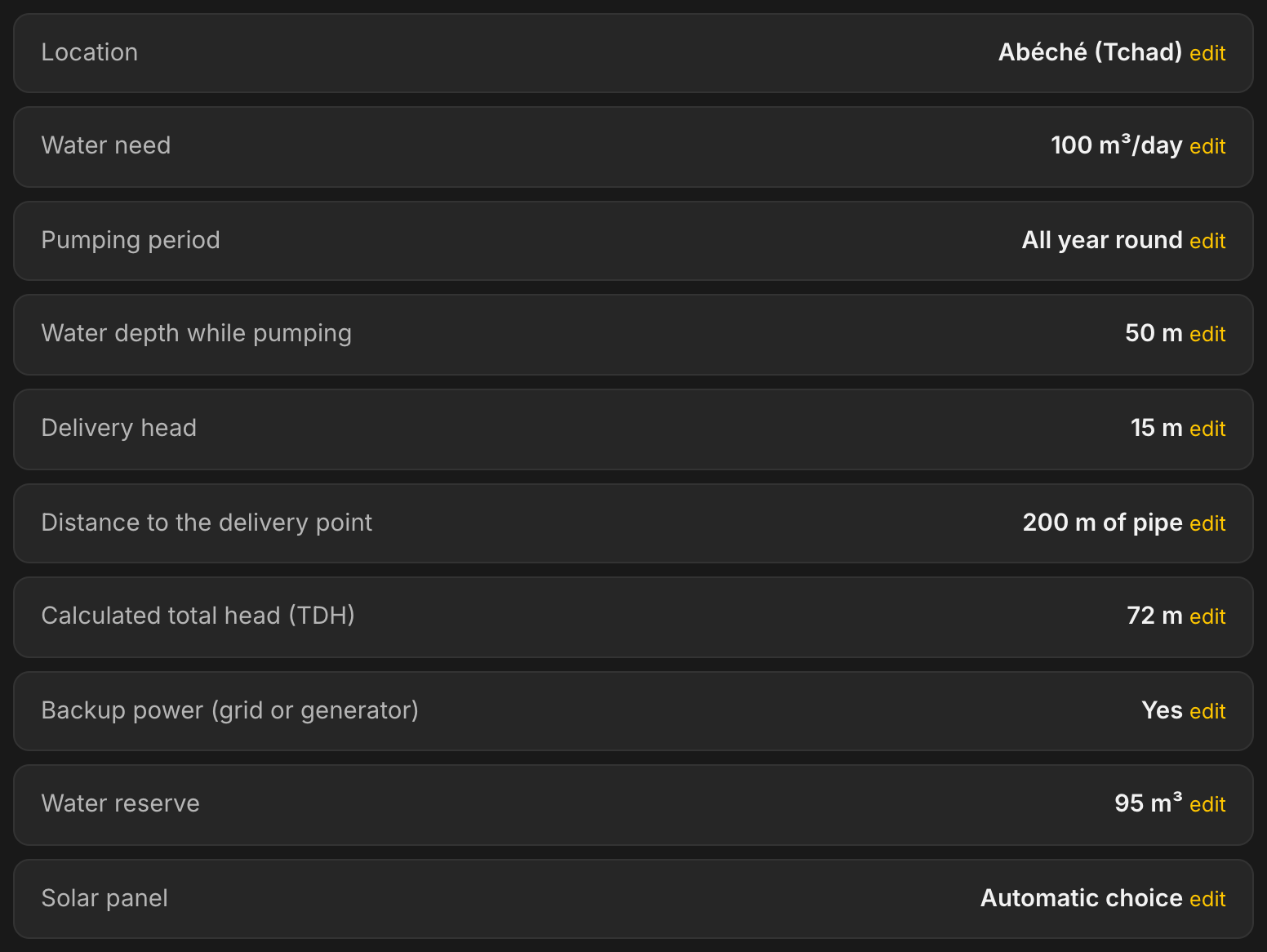
The summary before calculation: nine answers are enough, the total dynamic head is calculated for you.
What LE LAB proposes: a 100% hybrid solution
The chosen solution is a LORENTZ PSk3-15 with the C-SJ17-11 end, and the tile announces it on its own: "100% hybrid". The solar array has 17 panels of 515 Wp in a single string, for 8,755 Wp, with an average production of 110.5 m³ per day, from 83.1 m³/day in August to 128.0 in February. The single string is not a whim: the PSk3 controller operates at high voltage and the array is adjusted by whole string. The pump is rated for 25 m³/h and 90 m at most: at the project's head, 72 m, it stays inside its curves.
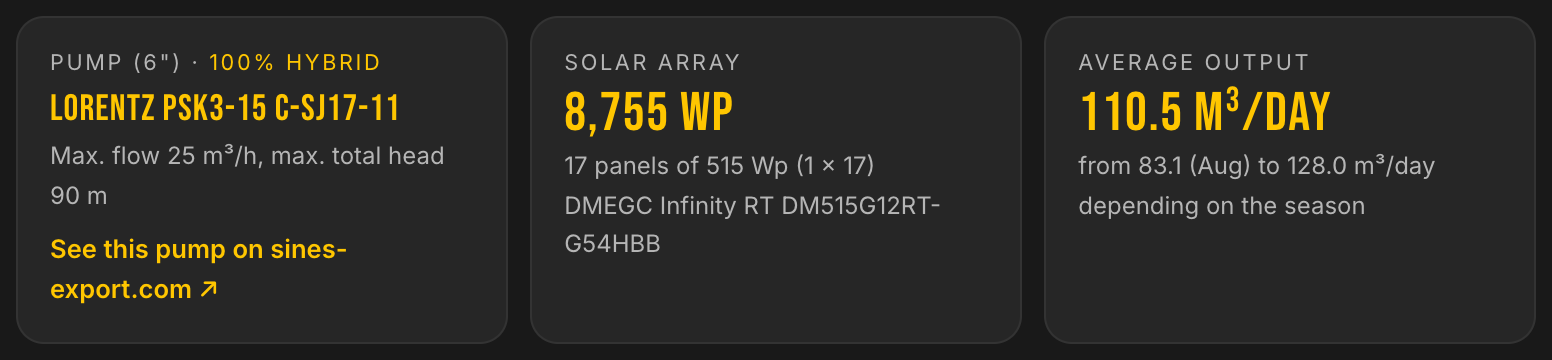
The solution at a glance: the "100% hybrid" label is carried by the pump itself.
Production, month by month: the Sahelian sun carries the dry season
Over sixteen years of the region's PVGIS solar history, nine months stay above the 100 m³ line and three fall below: June at 94.2 m³ per day, July at 84.8 and August at 83.1, at the heart of the rainy season, for the worst August observed at 5.0 kWh/m²/day. The rainfall curve tells Abéché's climate: 0 mm in January, 181 mm in August. Solar alone carries the dry season; during the rains, the generator takes over.
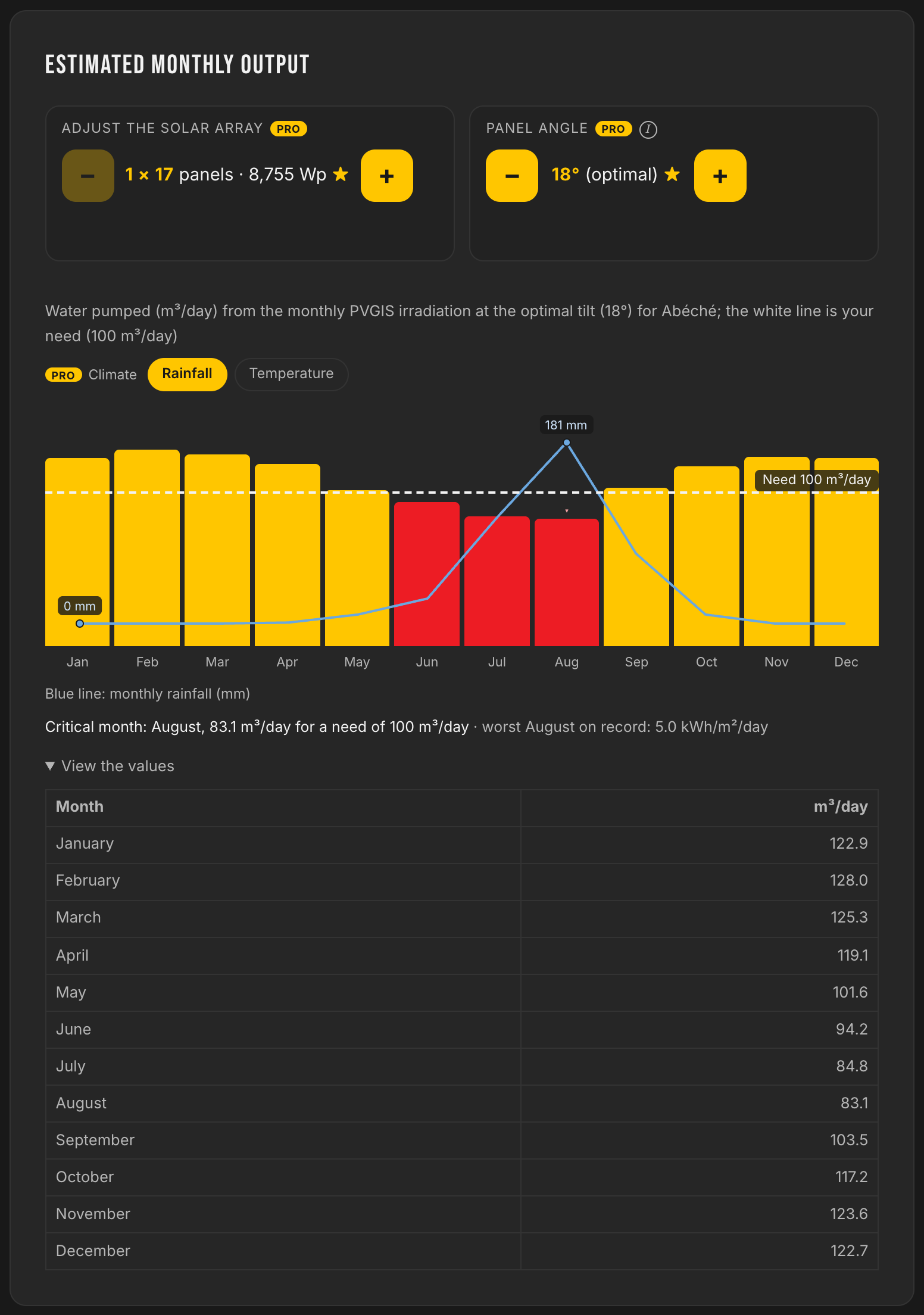
The critical month is shown: August, 83.1 m³/day for 100 required. The blue line is monthly rainfall.
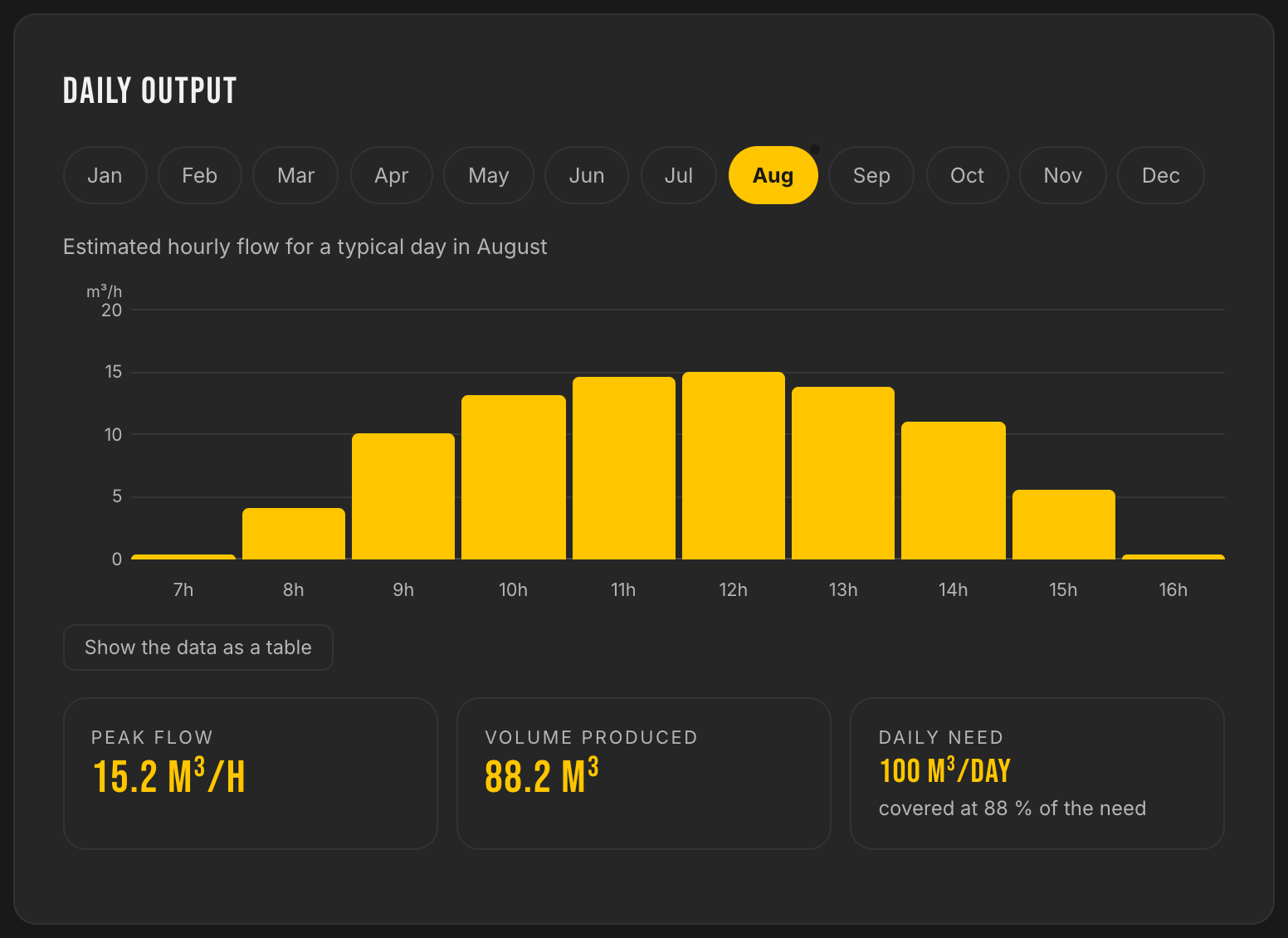
The typical August day peaks at 15.2 m³/h for 88.2 m³ produced, 88% of that day's need.
The 95 m³ reservoirs, and what is left to the generator
LE LAB simulates the water reserve day by day over sixteen years of PVGIS weather history. With the existing 95 m³, 313 of 365 days are fully covered by solar alone. The app flags the coverage as insufficient: 52 days a year on average remain incomplete, concentrated from June to August, at 74% of the need, an annual shortfall of 1,341 m³ out of 36,525, or 3.7%. The worst episode of the sixteen years runs from 9 May to 30 August 2012, 114 days of low sun. That is exactly the generator's job.
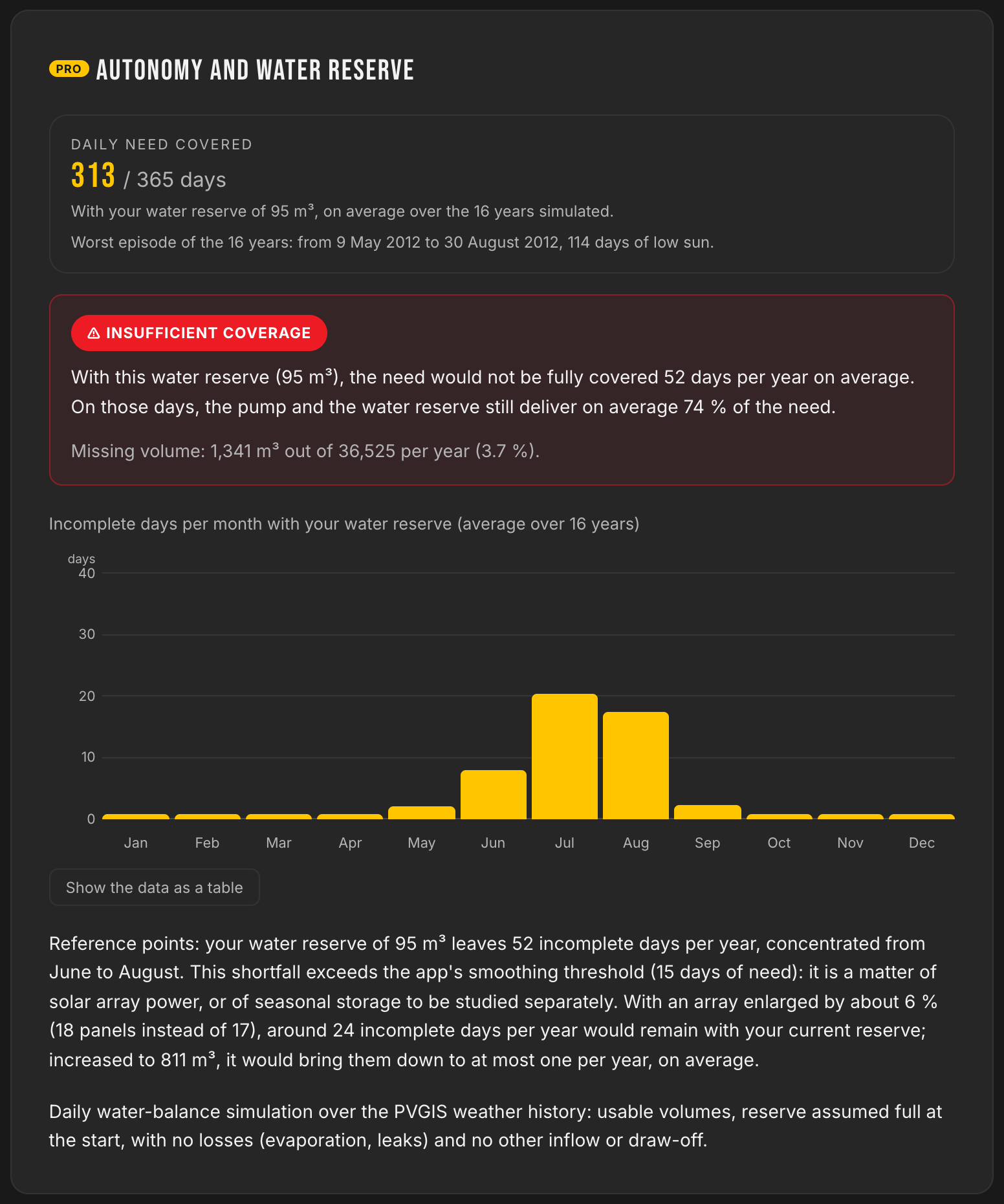
The benchmarks show the price of all-solar: 811 m³ of reservoirs instead of the 95 m³ in place. No one pours that concrete when a generator is already there.
Manufacturer curves, at the real operating point
The pump's Q/H curves, plotted from official LORENTZ data, with the project's head highlighted: 18.5 m³/h at 72 m. The C-SJ17-11 accepts up to 25 m³/h and 90 m: at this head the pump stays inside its curves, and it is the available solar power that sets the flow, not the pump.
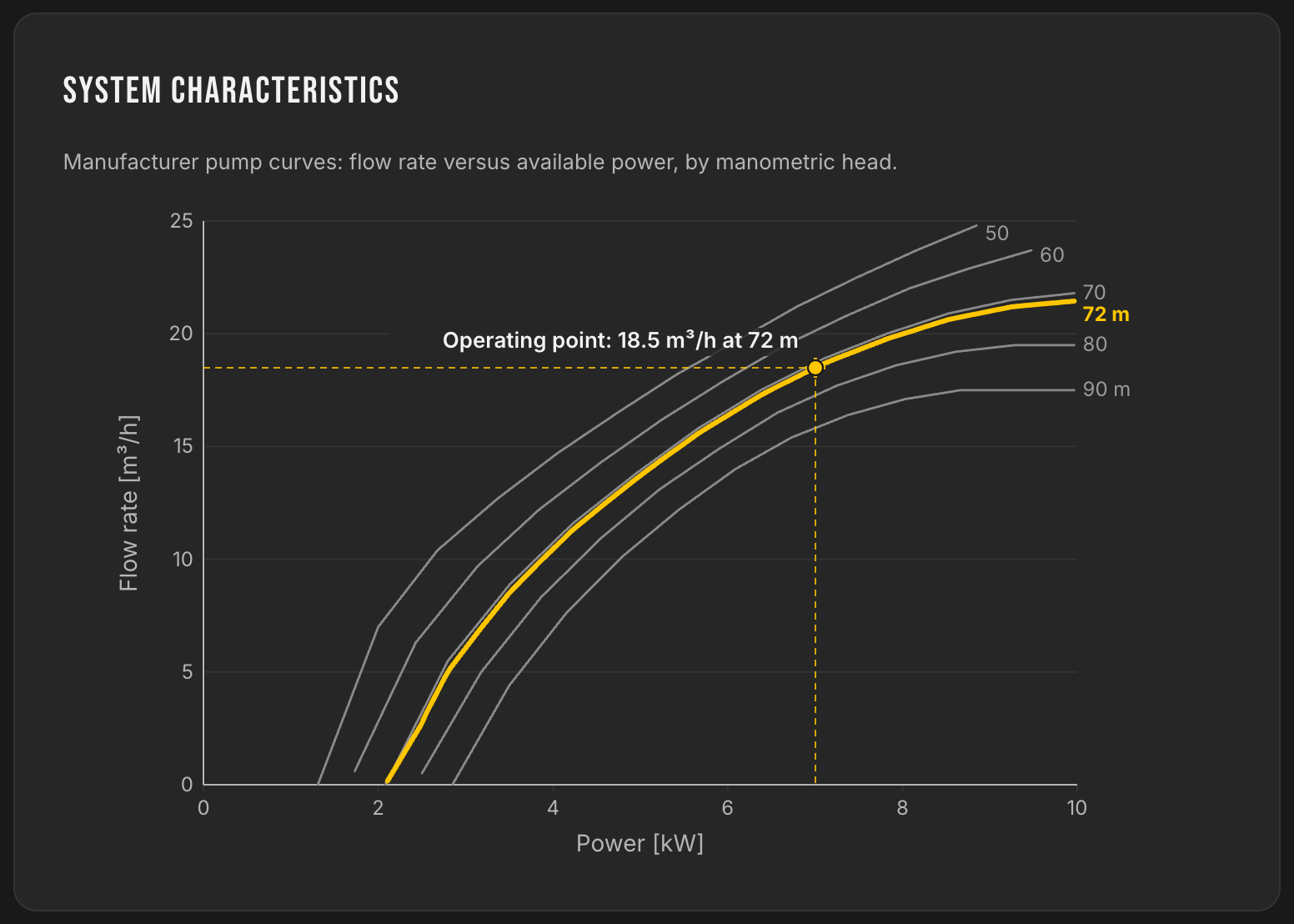
Flow according to available power, by head. The yellow curve is the project's, at 72 m.
The tool frames, the trade decides
Your project deserves the same study
Replay this study with your own figures: location, need, borehole, backup power. Free, no registration, results in a few minutes.